
“The Lamb Lies Down” for Genesis, “Stands Up” half-century later for Rialto-ready Steve Hackett
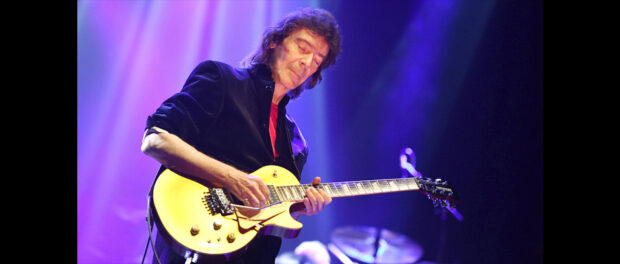 Photos provided by Lee Millward, Diana Seifert and David Clay
Before Genesis even released “The Lamb Lies Down On Broadway,” arguably its most ambitious album ever, the future Rock and Roll Hall of Famers, then comprised of front man/flutist Peter Gabriel, keyboardist Tony Banks, lead guitarist Steve Hackett, bassist/12-string guitarist Mike Rutherford and drummer Phil Collins, decided to play the entire double opus live.
Considering this was eons prior to the internet existing where live footage and leaked set lists spread like wildfire, fans expecting to hear prior staples such as “Supper’s Ready,” “Firth Of Fifth” and “I Know What I Like (In Your Wardrobe)” were instead thrust into a trippy narrative of a rebellious main character, Rael, navigating a bizarre yet ultimately redemptive journey of intense self-discovery in New York, set to a meticulously-synchronized slide show that rarely worked.
Not only were fans left completely shocked and scratching their heads as to exactly what they witnessed, but the band was still reeling from the grueling recording sessions, interpersonal tensions and the confidential news its singer would soon be stepping down to further find himself on “Solsbury Hill.”
Fast-forward half a century later through the lens of additional explanations or reappraisals, and it’s become a bonafide cult classic, enshrined on a remastered box set, alongside Hackett’s reimagined and reinvigorated U.K. rock chart-topper, “The Lamb Stands Up Live At The Royal Albert Hall.”
In fact, that latter legend is now the sole member actively performing material by the prog gods turned stadium-filling juggernaut throughout the aptly titled “Genesis Greats, Lamb Highlights & Solo” Tour,” coming to the Rialto Square Theatre in Joliet on Thursday, November 6, which as he tells Chicago Concert Reviews during a series of thoroughly revealing reflections, just so happens to be the very first region on the entire planet where this concept collection was debuted all those decades ago!
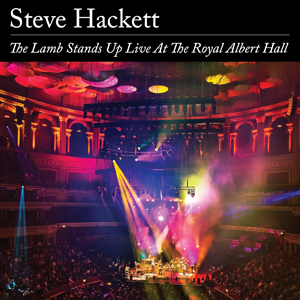 What are your hopes for “The Lamb Stands Up Live At The Royal Albert Hall”?
Steve Hackett: Well, it went to number one in the rock charts in the U.K. and it seems to be doing very well in the German charts. America is another story. If it takes off there, then that’s fine. I mean at one time, each album that I did, I was always hoping that it would do well, including the Genesis days, but these days, I think I’m more realistic. What I say to myself is, “it will join the rest of the canon. It joins the rest of the legacy,” not just what I’ve done, but everything that all the guys from Genesis have done. I think there’s no point in losing sleep over that. I may have printed this before, but fairly recently I’ve heard that John Lennon said, “Genesis were true sons of The Beatles.” I thought it was the best review we could ever have! Whenever I might be struggling to come up with a song or a solution for a passage in a song, I can fall back on that…
I think the whole life lesson with this and the lesson for art is the idea that just because your opus failed or your latest greatest hit went down the toilet, it doesn’t mean to say that down the line [it won’t amount to something]. If I’m doing “The Lamb Lies Down On Broadway,” nine songs from it, that helps to promote the album all over again and also this box set could be a hit all over again. Maybe a bigger hit than it was first time around! You just don’t know with this stuff. It’s a crazy business. We’re reinventing the wheel every time and hoping that it runs smoothly.
How do you recall “The Lamb” being received when it was initially released?
Hackett: People were baffled because we were out there promoting an album which hadn’t yet been released. Its release was delayed and we were already touring in America. We weren’t doing any recognizable songs, so even the die hards of Genesis at this point, [were not hearing] “Selling England By The Pound,” “Foxtrot,” “Nursery Crime,” not to mention “Trespass” and “From Genesis To Revelation.” I think it was a hard sell.
It was very difficult because it was a concept album. It was a double album. It was an English band singing about a punk in New York, so there was credibility running against it. There was the release date that was running against it. There was the lack of recognizability about it other than the fact it was a confrontational approach by a young band. Pete wanted to have the new stuff out there at all costs and to hell with the old idea of romantic Genesis, but you’ve got a band that’s pulling in two different directions. You’ve still got the romantic side, but you’ve got the hard-edged approach from Pete.
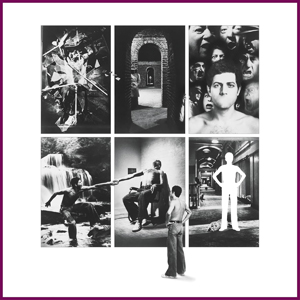 We’re talking 51 years ago. It’s pretty much like people talking about [Yes’ previously polarizing album] “Tales From Topographic Oceans.” It’s been out there. It can be relevant to today or it can be perceived as a relic. I choose to honor the early work and I treat it as if it’s classic or classical. When I do it live, myself, I’m not really speaking with a group voice. This is free of politics. I choose the tracks that I think are most relevant to me where the guitar has got something to say. I think it’s very difficult for a band to talk dispassionately about something that was of that time. There will be a remix of this. There will be at Atmos mix. The reality is that everyone’s been talking about band reformations at this point. That seems hardly likely to happen. I think I’m the closest thing to it…
In going back through the remixes and interviews, have you had any fresh perspectives on this “Lamb” period?
Hackett: I think so. I’ve done the occasional interview and I’ve walked into the studio and people were playing some of this material, like “The Chamber Of 32 Doors.” I heard it on British radio. It was never played on British radio when it was current, and then it was being played and I thought it sounded great on radio. Super compressed perhaps, but I can do a re-record at some point and fix that guitar cause I always wanted that guitar note to sustain at the beginning and the damn thing wouldn’t. [I could] give it what it always should’ve had. I want my version to be better (laughs).
When it came time for your concert recording, what inspired the decision to flip the title of the original album from “Lies Down” to “Stands Up”?
Hackett: I think that music does stand up and it stands the test of time. Of course, it’s a play on words and I wanted to do pieces that would work separately so they’re not bound to the narrative. In other words, there’s no point in trying to do the whole thing cause that would mean I couldn’t play anything else and I am playing other Genesis tracks.
Can you give us a preview of what the Rialto Square Theatre can expect?
Hackett: I’m looking forward to Chicago. I always love it. On this tour, I’m doing the whole of “Supper’s Ready,” for instance. It still leaves me time to do nine tracks from “The Lamb Lies Down On Broadway” and also do more recent stuff that I’ve done. Some people show up because they prefer my new stuff, strange as it may seem, cause I’ve been lucky enough to have stuff chart. Now it’s ironic that my last studio album, “The Circus And The Nightwhale” went to the top of the rock charts over here, in the U.K. Same thing happened with “The Lamb Stands Up.” The perfect story would be “Genesis is reforming and they’re gonna re-release this. It’s gonna be a big box set and they’re gonna be out there playing it themselves.” At one point Peter Gabriel was saying, “or they could be avatars!” This is before ABBA were doing it, avatars of themselves looking young and vital.
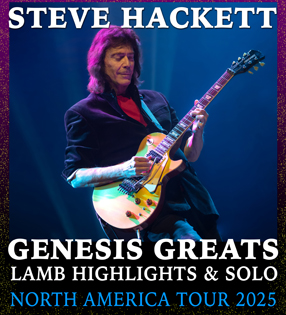 As I say, I honor the early work. I’ve done the whole of “Selling England By The Pound.” I’ve done the whole of “Foxtrot.” I don’t want to do the whole of “Lamb” because that’s 90 minutes. It doesn’t leave any room for anything current, but currently, I do three tracks straight off from “The Circus And The Nightwhale.” There’s also a little acoustic album called “Live Magic At Trading Boundaries,” that for some reason, sales of that have gone ballistic and most of that is not even current material. Some of it is classical music. Some of it is arguably more like flamenco. It’s acoustic music, but because I delve into all these various things, there are a lot spinning plates in the air at the moment.
Chicago’s Auditorium Theatre was the very first place where “The Lamb Lies Down On Broadway” was ever performed. What do you remember about that?
Hackett: It was an extraordinary day because we were gonna perform the whole of this new album, just trying to remember what was following what in one go. I was just hoping that my muscle memory was gonna kick in. [But then] I bit down on a pretzel the night before and broke a filling, so I had to go to a dentist. I also was having physical therapy for my thumb. Before the tour, I cut my thumb accidentally. I severed a tendon and a nerve, and my thumb wasn’t working…So on the day, I had a filling done, I go to physical therapy and the guy said to me, “we’re going to pass currents through your hand: AC and DC. One of ‘em makes you go [inward] and the other makes you go [outward].” I think the guy was a little bit sadistic and he was pushing it a little bit much. I’m jumping through hoops here, and in the evening, I’m gonna have to remember 90 minutes’ worth of music that I’ve never played before in my life! You wouldn’t ever design a day of challenges like that for yourself, would you? But it all happened and we did play. I can’t remember the audience reaction…I don’t think they were happy. They never heard the damn thing and we were playing the whole of it! It isn’t even released yet because it’s held up because of this, that and the other!
What were some of the challenges you faced before even going into these recordings?
Hackett: [We had] a lead singer that was shortly about to leave the band, and he was, in a way, already behaving like it was a solo project. Don’t get me wrong, I love Pete and I think he’s done great things, but at this point in time, there was so much tension within the group. Now I like to think that it’s made for a very good album, but Pete never did really believe in a thing called “composition by committee,” so I think he was biding his time until the moment when William Friedkin called him up and wanted him to do a screenplay of something that he was working on. Friedkin, of course, had great success with “The Exorcist,” which was the biggest horror film and box office smash of ’73. Anyway, so Pete left the band before we were making the album and then Friedkin freaked when he heard that he was gonna be breaking up Genesis, essentially, and said, “oh, no, no, I don’t want that.” Feathers that were rustled were smoothed by management and Pete rejoined. But I knew in my heart that Pete was not going to stay with the band. It was a very, very tense, tricky time. I think the group working atmosphere became very claustrophobic knowing we were dealing with this lack of certainty. Nonetheless, I think we all committed enough to make a really great album…
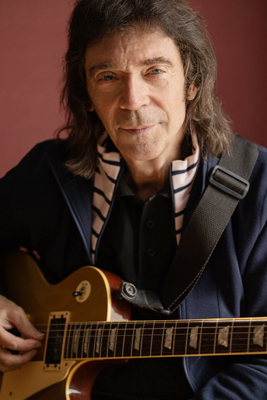 We were recording in the country rather than in town. A number of us had families and suddenly there were children involved. Pete was about to become a father and all of this weighed heavily. This was extra weight of expectation and maybe it would’ve been better if we’d been recording in London, but we weren’t. We were recording in Headley Grange because somebody had the great idea that Led Zeppelin have recorded there. “The great sound in the stairwell, the sound of ‘Kashmir’ and ‘Black Dog,’ let’s have some of that,” so we were following in the footsteps of Zeppelin. The problem is, in true Genesis style, it became a double album, so we had to move out of the place before a note was recorded and we moved up to another derelict building that wasn’t complete in Wales with a mobile, instead of recording in London, because mobile studios weren’t recording live like that. It was really in its infancy. People weren’t doing that in those days. There was no miniaturized digital stuff. This is the days of analog, so I’m giving you some background as to how the album was forged in fire, very fiery, not always smooth…
[Plus Pete’s] writing all these lyrics. He wants to write the whole story. He wants to sing his own words, completely understandable. I like to sing my own words, but at one time, we were all writing lyrics within the band. Suddenly we’re all demoted, apart from Pete, so it gives you an idea of what the band atmosphere must have been like and the band politics. Not the easiest of things.
Do you have an interpretation of his storyline?
Hackett: I think it’s a story of redemption, in a way, but redemption in the world as we know it, so it’s a modern allegory. Now having read some Joseph Campbell, which helped at the time, I had become aware of the moment when someone sacrifices themselves, the idea of no man [having] greater love than he who lays down his life for his brother. I think this Biblical thing is being referred to in the closing stages of the lyric, just before you get to “It.” The moment that Rael realizes the person he’s saving is actually himself and not just his brother, there’s a cosmic, not a conundrum, but kind of a cosmic about face that happens in a situation like that. There are people who’ve sacrificed themselves for others, and in this imaginary story, this is what Rael is doing.
I also think that the story was kind of an allegory of the agonies that Pete was going through himself. When you listen to “The Chamber Of 32 Doors,” where the song is talking about lack of certainty or “where should I go next?” My mother says one thing. My father said the other. The same lyric comes out again when Pete’s doing “Solsbury Hill,” the other work, the idea of separation, perhaps from the band, leaving the mothership, leaving a kind of Eden if I’m going to use Biblical imagery here. It’s the same things that come up, so I think there’s Rael, but Rael is really Pete.
It what ways might the sounds may have shaped those who followed in your footsteps?
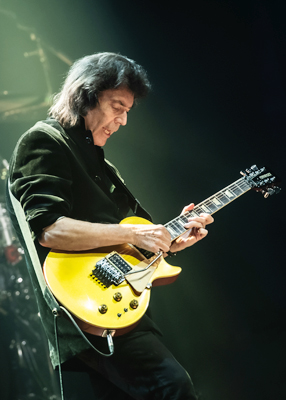 Hackett: I think they’ve been very inspirational to a number of people. We were using some of the same technology that [Roxy Music member turned solo artist and super producer Brian] Eno was using, stuff like the EMS Synthi Hi-Fli guitar synthesizer that he was putting things through. He did a day’s work with us during that, so I think there were some techniques that became perhaps standard practice. We were always trying to get this sort of digital delay line stuff, which The Beatles had pioneered, and automatic double tracking. When Pete was working with Phil Collins doing his solo album, I think that was a kind of production approach that colored everything in the 1980s, compressed ambient mics, that kind of thing. But I think before that, I think it probably made it possible for Brian Eno to become a producer, the fact that he’d just spent a day’s work with us, but it was sufficient [enough] to have an impact.
I think over time, Genesis did influence a lot of musicians and I’m amazed to find out just how many of them there were and just how bloody famous they were. I had no idea at the time, believe me! Here’s me thinking, “Oh I’m functioning in my own little band called Genesis and out there there’s all these other big bands.” It wasn’t in the media. It was all undercurrents. No one could Tweet any of this stuff. Media hadn’t really caught on to Genesis. Radio play was scant, if non-existent, so here we are all these years down the line looking at something that’s regarded as a classic, but I’m just telling you how damn difficult it was at the time (laughs).
What did being a part of Genesis for so long provide as you went solo?
Hackett: It showed me how to do things, how to write songs. I learned from everybody, but then I had a lot of un-learning to do as well because I wanted to go my own way and not be tied too much to the Genesis formula. Take from it what you wanted, leave behind what you didn’t.
Steve Hackett performs at the Rialto Square Theatre on Thursday, November 6. For additional details, visit HackettSongs.com, RialtoSquare.com and NiteLite.com.
Related Articles
 Steve Hackett ensures “The Lamb Lies Down” and “Stands Up” during Rialto nod to Genesis
 “Supper’s Ready”: Steve Hackett’s “The Circus And The Nightwhale,” Genesis’ “Foxtrot At Fifty”
 Rock and Roll Hall of Famer Steve Hackett goes inside the pages of “A Genesis In My Bed”
 Genesis guitarist Steve Hackett leans acoustic and orchestral “Under A Mediterranean Sky”
 Mind-blowing Steve Hackett samples solo “Surrender,” last Genesis supper “Seconds Out”
 Genesis’ entire “England,” “Spectral,” “Edge” slices comprise sumptuous Steve Hackett helping
 Steve Hackett (Genesis): “Seconds Out + More” Tour at Copernicus Center
 Steve Hackett revitalizes Genesis’ entire “Foxtrot” as Copernicus Center is a “Watcher Of The Skies”